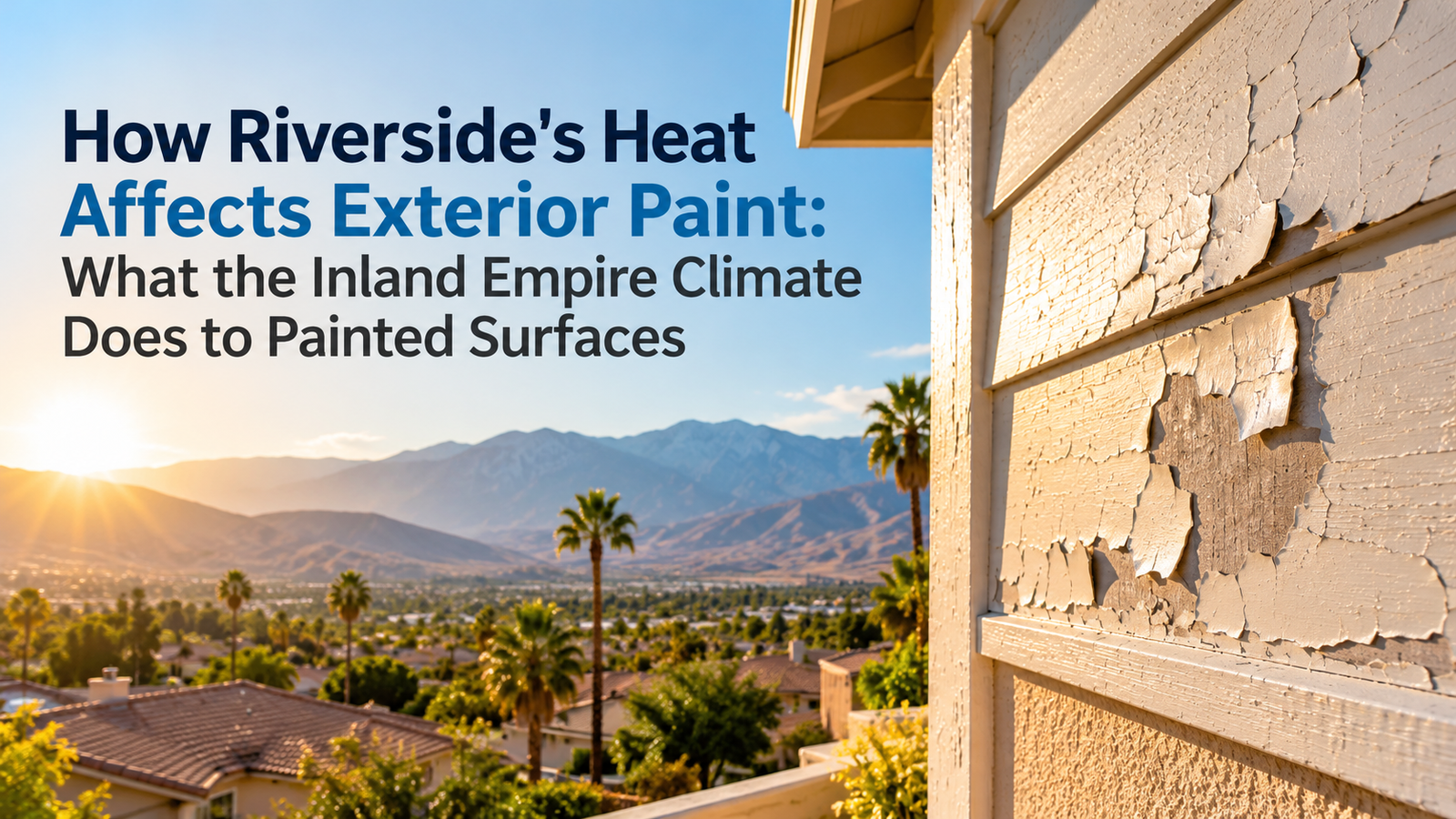
Exterior paint in Riverside, California faces environmental conditions that rank among the most demanding for painted surfaces in the continental United States. The Inland Empire’s climate hot, dry summers with intense UV radiation, wide daily temperature swings, and periodic Santa Ana wind events accelerates every form of paint degradation that occurs in more moderate climates. Understanding how Riverside’s heat and UV environment affects Riverside Heat Exterior Paint coatings helps homeowners and property managers make informed decisions about paint selection, preparation, and maintenance timing.
UV Radiation: The Primary Driver of Paint Failure
The Inland Empire receives one of the highest annual UV radiation doses in the contiguous United States. Riverside’s elevation (roughly 800 to 1,000 feet above sea level in the city), its low-humidity clear air, and its position east of the coastal marine layer that moderates temperatures in Los Angeles all contribute to intense UV exposure.
UV radiation attacks exterior paint through photodegradation breaking the polymer chains in the paint film that give it flexibility, adhesion, and cohesion. Over time, photodegradation causes chalking (the formation of a powdery residue on the paint surface as the binder breaks down), color fading, and eventually film embrittlement and cracking. This process occurs in every climate, but in Riverside it happens at a rate roughly two to three times faster than in the Pacific Northwest or New England.
Deep or bright colors are particularly vulnerable to UV-driven color fade in Riverside. Dark colors absorb more solar energy, which increases paint surface temperatures and accelerates both photodegradation and thermal cycling damage. Pigments with low lightfastness the ability to resist color change under UV exposure fade noticeably within one to two years on south and west-facing surfaces in the Inland Empire.
Thermal Cycling: Expansion and Contraction Stress
Riverside’s temperature range is one of the widest in Southern California. Summer days regularly exceed 100°F; winter nights can drop to the high 30s and occasionally the low 30s. This daily and seasonal temperature range causes the painted substrate wood, stucco, fiber cement, or metal to expand and contract repeatedly.
A wooden surface expanding in summer heat and contracting in a cool winter night is moving continuously, and the paint film bonded to it must accommodate that movement. Paint films that have lost flexibility through UV photodegradation or age-related hardening cannot accommodate the substrate’s movement, and they crack typically along wood grain, at joints, or at edges where two substrates meet. Once cracked, the film allows moisture infiltration that accelerates substrate damage and further paint failure.
The coefficient of thermal expansion differs between different substrates and paint films. Metals expand more than wood, which expands more than masonry. On metal surfaces railings, doors, shutters Riverside’s temperature range creates significant movement demands on the paint film. High-quality exterior paints formulated for wide temperature range and UV exposure perform better on metal surfaces in this climate than standard exterior paints.
South and West Exposures: The Most Demanding Faces
Not all exterior surfaces in Riverside experience the same conditions. South-facing walls receive direct solar radiation for most of the day year-round; west-facing walls receive the intense afternoon sun when temperatures are at their peak. These two exposures are the most demanding for exterior paint in the Inland Empire, and paint failure typically appears earliest on south and west faces.
North-facing walls are in shade for much of the day and may actually experience more moisture-related problems mold, mildew, algae than UV-related failure, because lower temperatures and less direct sun keep these surfaces wetter. East-facing walls receive morning sun only and are generally intermediate in their degradation rate.
Paint selection for a home or commercial building in Riverside should account for these directional differences. Products with the highest UV resistance and the widest service temperature range are most valuable on south and west exposures. The north face may benefit from paint with higher mildewcide content to address biological growth.
Heat Blistering and Film Failure
Blistering bubbles that form in the paint film is a specific failure mode triggered by heat and moisture. When moisture is trapped beneath the paint film and then heated by direct sunlight, it vaporizes and pushes the paint film outward, creating a blister. In Riverside, where summer pavement and wall surface temperatures can reach 150 to 160°F in direct sun, even small amounts of substrate moisture can cause blistering on south and west exposures.
The root cause of blistering is usually moisture in the substrate wood that was wet when painted, or wood that has absorbed moisture through back-side infiltration (inadequate vapor retarder or moisture pathway from the interior). Applying new paint over an existing blister problem does not solve the issue; the substrate moisture source must be identified and eliminated before repainting.
Applying paint in direct afternoon sun on Riverside’s hottest days is a contributing cause of blistering and other application failures. Exterior paint should ideally be applied when surface temperatures are below 90°F in Riverside’s summer, this typically means morning application on east and north faces, with south and west faces painted in early morning before direct sun hits them.
Paint Selection for Riverside’s Climate
100% acrylic latex exterior paint is the standard recommendation for Riverside’s climate. Acrylic binders maintain flexibility over a wider temperature range and resist UV degradation better than alkyd (oil-based) paints, which tend to become brittle over time in high-UV environments. The solids content of the paint the percentage that remains after water evaporates directly affects durability; higher-solids paints form thicker films that resist UV penetration more effectively.
Elastomeric coatings thick, rubber-like coatings formulated for masonry and stucco are particularly well-suited for Riverside buildings with stucco exteriors, which are the majority of homes built here. Elastomeric coatings bridge hairline cracks, accommodate substrate movement, and provide excellent UV and moisture resistance. Their high film build provides more UV protection per coat than standard paint, which is especially valuable on south and west exposures.
California Air Resources Board (CARB) regulations limit the VOC content of exterior paints sold in California, which has driven the market toward water-based formulations with lower solvent content. CARB-compliant paints available in Southern California today provide excellent performance without the high-VOC formulations used historically, and most major paint manufacturers produce CARB-compliant exterior products specifically formulated for Southern California’s climate demands.
Timing Exterior Painting in Riverside
The optimal seasons for exterior painting in Riverside are spring (March through May) and fall (September through November), when temperatures are moderate, UV intensity is lower than midsummer, and there is adequate drying time between coats. Summer painting is possible but requires scheduling to avoid the hottest part of the day and the most intense direct sun.
Winter painting in Riverside is feasible temperatures rarely drop below the minimum application temperatures specified by paint manufacturers (typically 50°F). The shorter days and lower UV intensity of winter actually reduce the risk of application failures like blistering and bubbling, though paint takes longer to dry and cure in cooler conditions.
Frequently Asked Questions: Exterior Paint and Riverside’s Heat
Why does paint fade faster on my south-facing wall than the north?
South-facing walls receive direct solar radiation for most of the day and accumulate significantly more UV exposure than north-facing walls. UV radiation breaks down pigment molecules and the paint’s polymer binder, causing color fading and eventually film degradation. The effect is compounded by higher surface temperatures on south-facing walls, which accelerate photodegradation. Using exterior paint with high-quality UV-resistant pigments and binders reduces but does not eliminate this differential fading.
How long should exterior paint last on a Riverside home?
In Riverside’s climate, a quality exterior paint job on a properly prepared surface typically lasts 5 to 8 years on south and west exposures before significant fading, chalking, or cracking requires repainting. North and east exposures may last 8 to 12 years. These intervals can be extended by using high-quality paint with maximum UV protection and by maintaining the paint film washing annually, caulking cracks before they admit moisture, and addressing early failures promptly.
What is chalking and is it a sign that repainting is needed?
Chalking is the formation of a powdery residue on the paint surface as UV radiation breaks down the paint binder, releasing pigment particles. Light chalking is normal wear; it can often be removed by washing and does not necessarily mean immediate repainting is required. Heavy chalking where the powder is thick and the paint film has lost significant thickness indicates the paint is nearing the end of its useful life. New paint applied over a heavily chalked surface will not bond well; the chalk must be thoroughly removed before repainting.
Can I paint in summer in Riverside?
Yes with scheduling adjustments. Avoid painting surfaces in direct summer sun when surface temperatures exceed 90 to 95°F. This typically means painting east and north faces in the morning and completing south and west face work in early morning before direct sun exposure reaches those surfaces. Painting in the afternoon in summer on south or west exposures risks blistering, poor flow, and rapid drying that prevents proper film formation.